IPTV vs Cable TV: Which One Should You Choose in 2026?
IPTV vs Cable TV: Which One Should You Choose?
For decades, cable TV was one of the standard ways to watch live television.
Today, viewers have more options. IPTV delivers television through Internet Protocol networks, while traditional cable TV continues to provide channels through a cable operator's television network.
This has made the decision more complicated.
Should you continue paying for cable, or switch to IPTV with Smartiflix platform?
The answer depends on what matters most to you.
If you want flexible device support, internet-based streaming, and a setup that can work without a traditional cable box, IPTV may be attractive.
If you prefer a provider-managed television service that does not rely on your home internet connection for traditional TV reception, cable may still make sense.
In this guide, we compare IPTV vs cable TV across cost, reliability, picture quality, sports, entertainment, installation, device compatibility, portability, and everyday convenience.
Only use IPTV services and content that you are legally authorized to access. Find out why Smartiflix, your top Premium IPTV in USA, Europe & Canada, is the best choice.
IPTV vs Cable TV: Quick Answer
There is no single winner for every household.
IPTV may be a better fit if you:
- Have a stable broadband connection.
- Prefer streaming applications.
- Want to use multiple compatible devices.
- Watch television on Smart TVs, Android TV, streaming devices, phones, tablets, or computers. See installation guides.
- Prefer a flexible setup without traditional cable hardware.
- Want internet-based features such as on-demand content where supported.
Cable TV may be a better fit if you:
- Already have a reliable cable TV installation.
- Prefer a traditional television experience.
- Want TV service that does not depend on your home broadband connection for the main TV feed.
- Prefer a provider-managed set-top box and channel guide.
- Live somewhere with limited or unreliable broadband.
The right choice depends on your specific provider, location, internet connection, budget, and viewing habits.
What Is IPTV?
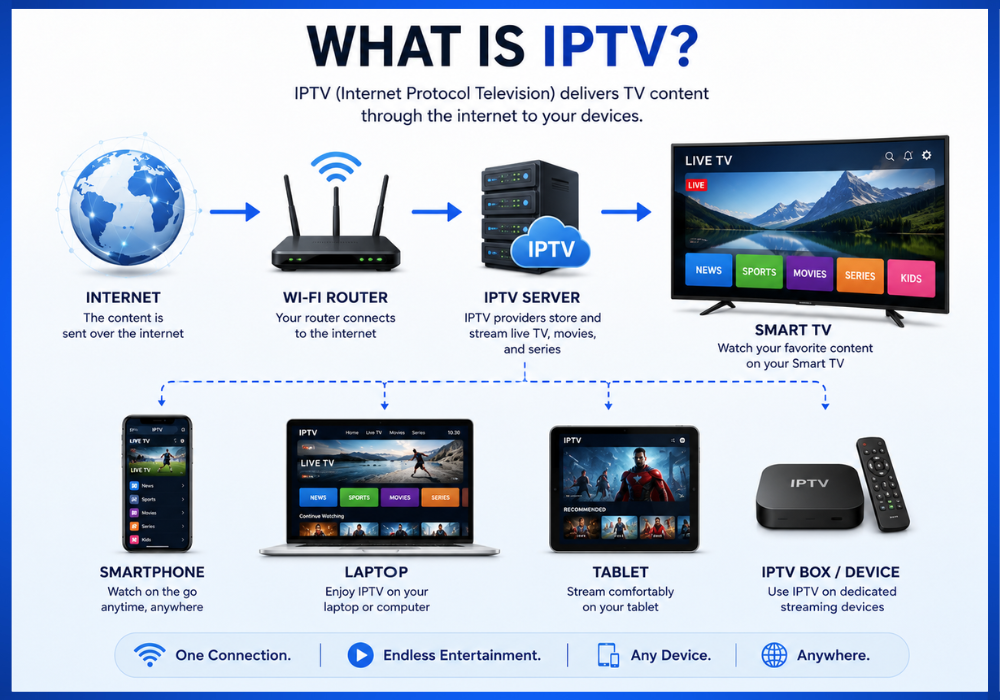
IPTV stands for Internet Protocol Television.
It describes the delivery of television content using Internet Protocol networks.
Depending on the service, IPTV can include:
- Live television
- On-demand video
- Electronic program guides
- Catch-up features
- Compatible streaming applications
A typical internet-based IPTV setup may include:
- Internet connection
- Compatible device
- IPTV application or player
- Authorized IPTV service or account (such as Smartiflix plans)
One of the main advantages of internet-based IPTV is that it can work across different compatible devices.
However, the exact devices and features depend on the service and its applications.
What Is Cable TV?
Traditional cable TV delivers television programming through a cable operator's network, historically using coaxial cable and increasingly using a mixture of modern network technologies.
A traditional cable setup may include:
- Cable connection
- Set-top box
- Television
- Remote control
- Cable TV subscription
Cable providers often bundle television with internet and other communication services.
Modern cable companies may also provide mobile applications and streaming options, so the distinction between cable TV and streaming can sometimes be less obvious than it was in the past.
How IPTV and Cable TV Work
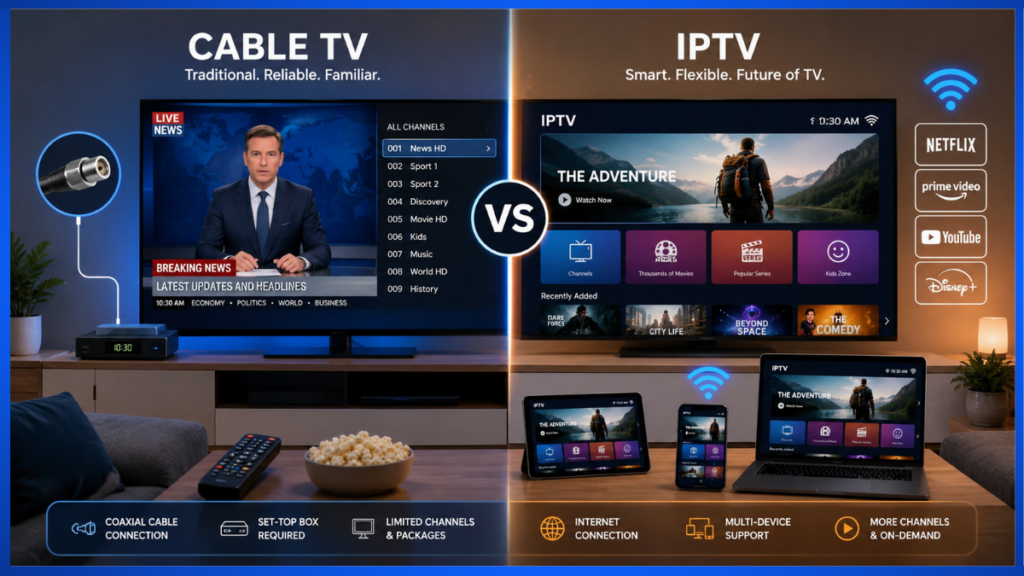 Internet-based IPTV compared with traditional cable television
The biggest difference is the delivery path.
IPTV
Internet-based IPTV generally follows a path similar to:
Content source → Internet/network → Router → IPTV application → Device
The available performance depends heavily on the quality of the connection and the service.
Traditional Cable TV
Traditional cable follows a path more like:
Cable provider → Cable network → Home cable connection → Receiver/set-top box → Television
This means traditional cable television does not necessarily depend on your home broadband connection in the same way that public-internet streaming does.
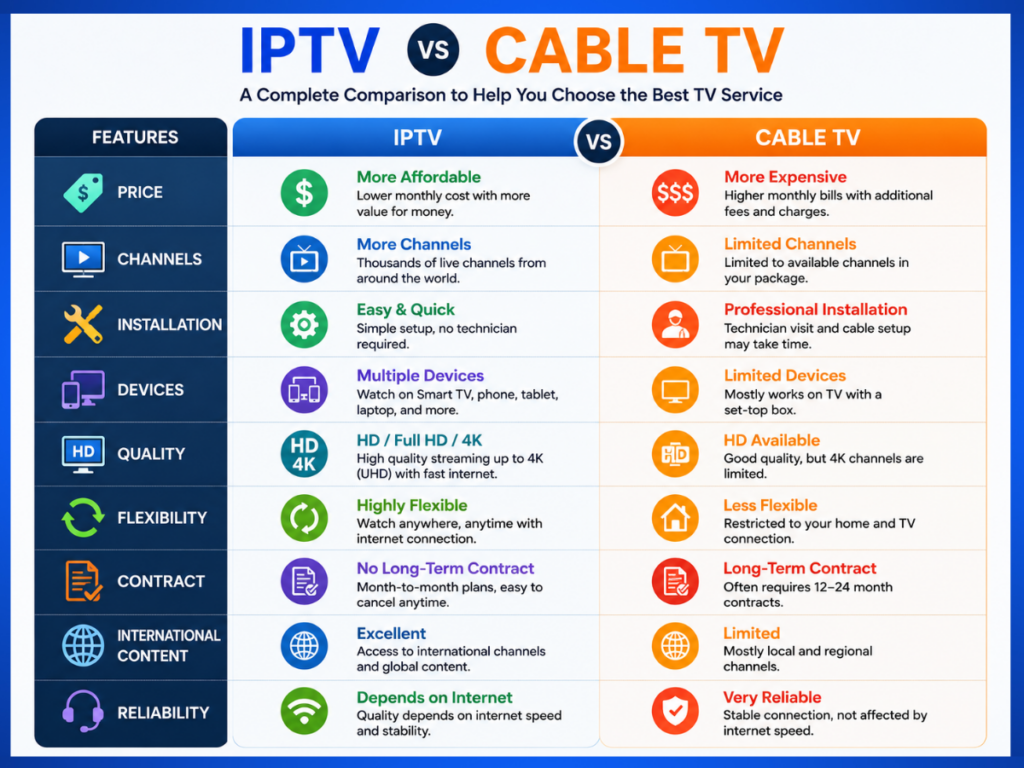
IPTV vs Cable TV: Comparison Table
| Feature | IPTV | Traditional Cable TV |
|---|---|---|
| Delivery | Internet/IP network | Cable operator network |
| Home broadband required | Usually yes for internet-based IPTV | Not necessarily for traditional TV |
| Set-top box | Often optional depending on service | Common |
| Installation | Usually app/device setup | Often physical installation |
| Device flexibility | Often high | Traditionally more limited |
| Smartphone support | Often available | Provider-dependent |
| Tablet support | Often available | Provider-dependent |
| Smart TV support | Often available | Provider-dependent |
| Portability | Generally higher | Generally lower |
| Weather sensitivity | Usually not directly affected | Usually not directly affected |
| Internet outage impact | Can stop playback | Traditional TV may continue |
| Picture quality | Depends on stream/service | Depends on provider/channel |
| On-demand content | Often available | Often available |
| DVR | Service-dependent | Often available |
| Contract | Service-dependent | Provider-dependent |
| Channel availability | Service and rights dependent | Provider and region dependent |
These are general patterns. Actual features vary by provider and region.
IPTV vs Cable TV: Cost
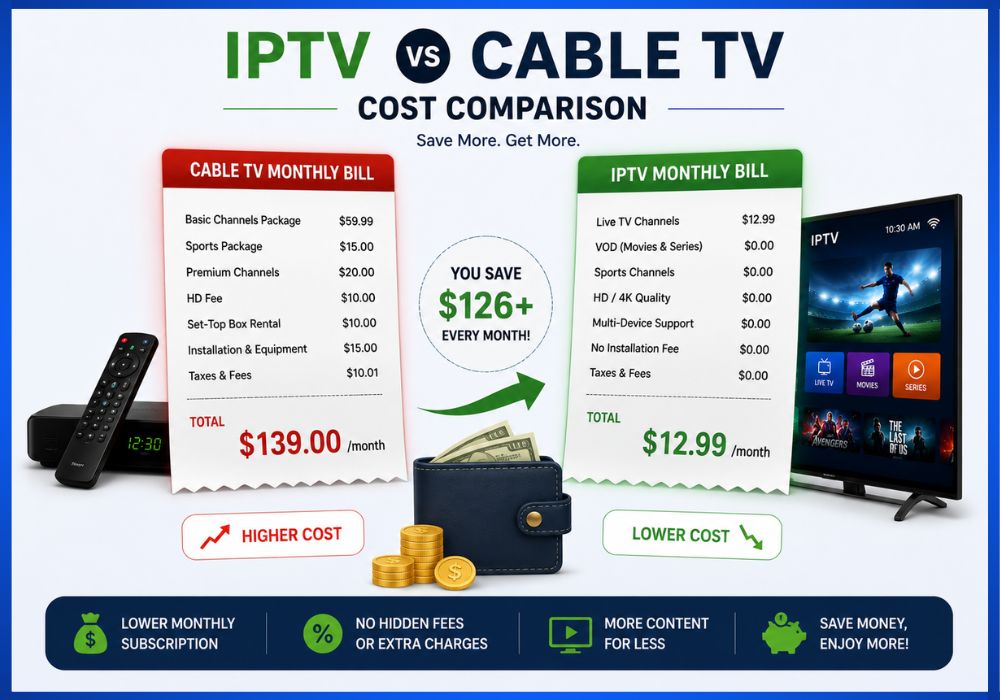 IPTV and cable TV cost and equipment comparison
Cost is one of the main reasons people compare IPTV and cable.
However, there is no single IPTV price or cable price that applies everywhere.
Your total cost can include:
IPTV
- IPTV service subscription
- Internet subscription
- Streaming device if needed
- Optional premium applications
If you already pay for broadband, the additional cost may be limited to the television service. View our IPTV pricing for details. and any necessary hardware.
Cable TV
- Television package
- Equipment rental
- DVR service
- Installation
- Premium channels
- Sports packages
- Additional receivers
- Taxes and provider fees
Cable may also be bundled with internet, making the real cost difficult to compare unless you calculate the entire monthly bill.
The Best Way to Compare Cost
Do not compare only the advertised subscription price.
Compare:
TV service + internet + equipment + installation + optional packages + recurring fees
This gives you a much more realistic picture of the total cost.
IPTV vs Cable TV: Installation
Installation is another important difference.
IPTV Installation
Internet-based IPTV typically requires:
- A working internet connection.
- A compatible device.
- A compatible IPTV application.
- An authorized service or account.
In many cases, the user can complete the setup without a technician.
Cable TV Installation
Traditional cable may require:
- A cable connection at the property.
- Installation or activation.
- A cable box or compatible equipment.
- Provider configuration.
The exact process depends on whether the home already has cable service installed.
For users who want minimal physical installation, IPTV can be more convenient.
IPTV vs Cable TV: Picture Quality
Both IPTV and cable can deliver high-definition and, where supported, 4K content.
Picture quality depends on several factors.
For IPTV:
- Stream bitrate
- Internet stability
- Compression
- Source quality
- Device capabilities
- Display resolution
For cable:
- Provider's bitrate
- Channel source
- Compression
- Broadcast resolution
- Receiver
- Television
Therefore, it is not accurate to say that IPTV automatically has better picture quality than cable.
A high-quality IPTV stream can look excellent, but a poorly encoded stream can look worse than a good cable broadcast.
The same principle applies in reverse.
IPTV vs Cable TV: Reliability
Reliability is one area where your specific setup matters enormously.
IPTV Reliability
Internet-based IPTV can be affected by:
- Internet outages
- Weak Wi-Fi
- Network congestion
- Packet loss
- Router problems
- Device problems
- Application issues
- Problems with the authorized streaming service
A stable broadband connection can provide a strong IPTV experience. To learn more about how internet speeds affect streams, see our article What Internet Speed Do You Need for IPTV?.
Cable Reliability
Traditional cable television operates through the cable provider's network rather than depending on your public internet connection for the TV feed.
This can be an advantage if your home internet connection is unstable.
However, cable can still experience outages caused by:
- Network failures
- Power outages
- Equipment problems
- Physical infrastructure damage
- Provider maintenance
Cable is not completely immune to interruptions.
IPTV vs Cable TV: Internet Dependency
This is one of the most important questions to ask.
IPTV
Internet-based IPTV depends on an internet connection.
If your broadband connection goes down, internet-based IPTV may stop working.
Traditional Cable TV
Traditional cable television does not necessarily require your separate broadband internet service to receive the TV signal.
This can make cable attractive for users who want television independent of their internet connection.
IPTV vs Cable TV: Channel Selection
Channel selection depends heavily on the specific service.
Cable providers usually offer packages divided into tiers.
These may include:
- Basic channels
- News
- Sports
- Entertainment
- Premium channels
- International packages
IPTV services can also offer different channel packages, but the available content depends on the authorized provider and applicable rights.
Do not judge a service solely by the number of channels advertised.
A smaller package with the channels you actually watch can be more useful than thousands of channels you never use.
IPTV vs Cable TV for Sports
 Watching sports and entertainment with IPTV and cable TV
Sports are often one of the biggest reasons people choose a television service.
IPTV for Sports
Internet-based IPTV can be attractive because compatible services may support multiple devices.
Depending on the authorized service and broadcasting rights, you may be able to watch sports on:
- Smart TV
- Android TV
- Streaming device
- Smartphone
- Tablet
- Computer
However, live sports are particularly sensitive to internet stability.
Buffering during a major event can be frustrating. For help optimizing your sports streams, read IPTV Buffering: 15 Causes and How to Fix It in 2026.
Cable TV for Sports
Cable remains popular for sports because traditional cable packages often integrate sports networks into dedicated channel packages.
Cable can be attractive if you want:
- Traditional live sports viewing
- Provider-managed sports packages
- Stable reception independent of home broadband
Sports availability varies by location and broadcasting rights.
IPTV vs Cable TV for Movies and Entertainment
For movies and entertainment, both options can work well.
Cable can provide:
- Movie channels
- TV series
- On-demand programming
- Premium networks
- DVR functionality
IPTV and internet-based services can provide:
- Live television
- On-demand video
- Catch-up features
- Compatible multi-device viewing
The important factor is the actual content catalog rather than simply whether the service uses IPTV or cable technology.
IPTV vs Cable TV: Device Compatibility
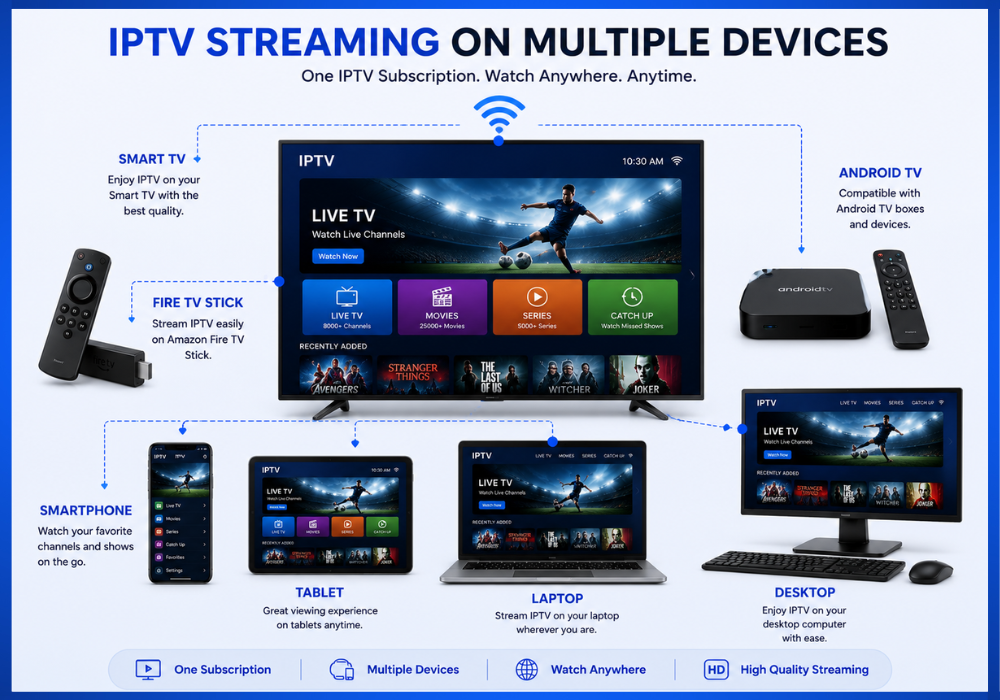
 IPTV streaming on multiple devices compared with cable TV
This is an area where IPTV can have a significant advantage.
Depending on the authorized service and application, IPTV may work on:
- Smart TVs
- Android TV
- Fire TV devices
- Smartphones
- Tablets
- Computers
- Streaming boxes
Traditional cable generally centers around a cable receiver and television, although many cable companies now offer companion applications and streaming services.
If you frequently switch between devices, check exactly what your provider supports before choosing. Read How to Set Up IPTV on Android TV in 2026 for examples of device setups.
IPTV vs Cable TV: Portability
Internet-based IPTV can be more portable.
A compatible device and internet connection may allow you to access your authorized service in locations where the service permits it.
Traditional cable is generally tied to a physical installation.
Moving a cable service can involve:
- Service transfer
- New installation
- Equipment changes
- Provider availability
For people who travel or move frequently, IPTV can offer more flexibility.
IPTV vs Cable TV: Contracts and Equipment
Contract terms vary considerably.
Some cable services may have contracts, while others are offered without long-term commitments.
Likewise, IPTV services can have different subscription periods and cancellation policies.
The same applies to equipment.
Cable commonly uses provider-supplied hardware.
IPTV may allow users to use devices they already own, although some services require or recommend specific hardware.
Always read the actual provider's current terms before subscribing.
IPTV vs Cable TV: Pros and Cons
IPTV Advantages
- Flexible device support
- Internet-based viewing
- Often simple setup
- Potentially portable
- Compatible with modern streaming devices
- Can integrate live and on-demand viewing
- No traditional cable installation in many setups
IPTV Disadvantages
- Depends on internet quality
- Can buffer when the connection is unstable
- Requires compatible hardware/software
- Features vary by provider
- Service quality can vary
- Content availability depends on rights
Cable TV Advantages
- Traditional and familiar experience
- Does not necessarily depend on broadband for TV reception
- Provider-managed hardware
- Strong integration with traditional channel packages
- Often useful for fixed-location viewing
Cable TV Disadvantages
- Physical installation may be required
- Equipment may involve recurring fees
- Less portable
- Device flexibility may be more limited
- Premium packages can increase the total bill
- Availability depends on the cable operator in your area
Which Is Better for Families?
Families should consider how many people use the service and what devices they watch on.
If everyone watches from one main television, cable can be convenient.
If different family members watch from different devices, an authorized IPTV or internet-based service may offer more flexibility.
However, check simultaneous-stream limits and account rules before subscribing.
Which Is Better for Travelers?
IPTV generally has the advantage in portability because compatible internet-based services can work on portable devices.
Cable is designed primarily around a fixed physical installation.
If you travel frequently, device compatibility and geographic restrictions should be checked before choosing a service.
Which Is Better for People With Slow Internet?
Cable may be the better option if your broadband connection is too slow or unreliable for consistent streaming.
Internet-based IPTV requires sufficient bandwidth and stability.
Before switching, test your actual internet connection on the device you intend to use.
Which Is Better for People With Fast Internet?
Users with stable broadband have more flexibility.
If your connection is fast and reliable, IPTV can be an attractive option because you can use compatible devices and streaming applications.
However, fast internet alone does not guarantee that every IPTV service will perform well.
The quality of the authorized service and your home network still matter.
Who Should Choose IPTV?
IPTV may be the right choice if you:
- Have stable broadband.
- Prefer streaming applications.
- Want multiple compatible devices.
- Want more portability.
- Prefer not to install traditional cable hardware.
- Watch TV on Smart TVs, streaming devices, phones, or tablets.
- Want flexible internet-based features.
Who Should Choose Cable TV?
Cable may be the better choice if you:
- Prefer a traditional TV setup.
- Want TV independent of your home broadband.
- Have unreliable internet.
- Already have cable equipment installed.
- Prefer provider-managed hardware.
- Primarily watch from one fixed television.
IPTV vs Cable TV: Which One Should You Choose?
There is no universal winner.
For a household with fast, stable internet and multiple compatible devices, IPTV can provide excellent flexibility.
For a household that wants a traditional provider-managed television experience or has unreliable broadband, cable can still be a practical choice.
The best approach is to compare the actual services available in your area rather than comparing the technologies in isolation.
Look at:
- Total monthly cost.
- Channel lineup.
- Sports availability.
- Local channels.
- Picture quality.
- Device compatibility.
- Internet requirements.
- Equipment fees.
- Contract terms.
- Customer support.
Final Verdict
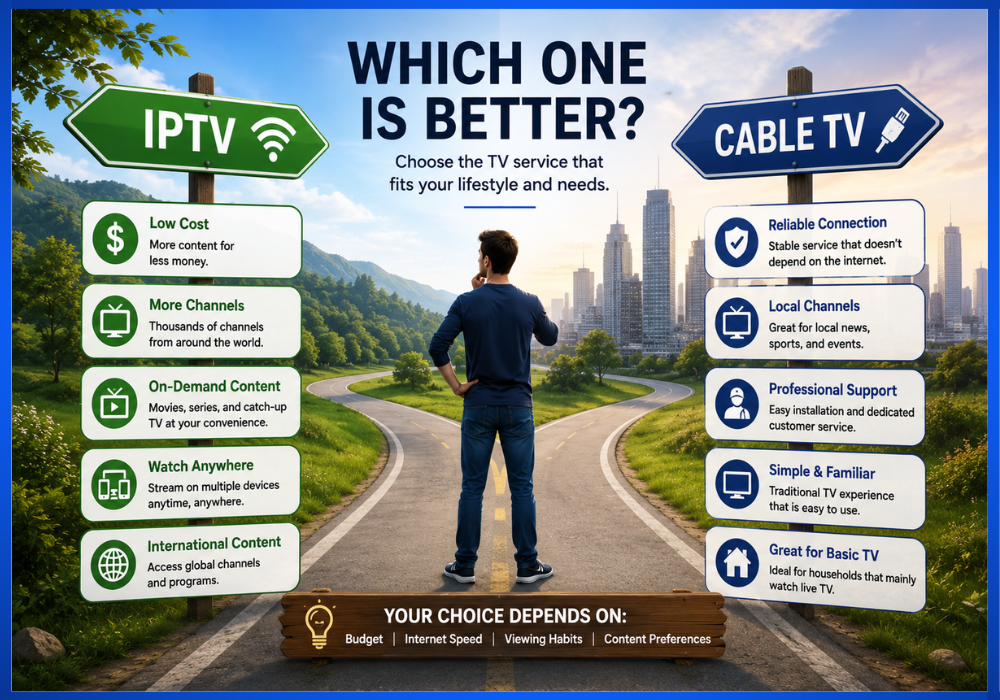 IPTV versus cable TV features comparison
| Your Priority | Better Fit |
|---|---|
| Multi-device viewing | IPTV |
| Portability | IPTV |
| App-based viewing | IPTV |
| Simple internet-based setup | IPTV |
| Stable broadband available | IPTV |
| Traditional TV experience | Cable |
| TV independent of home broadband | Cable |
| Fixed-location viewing | Cable |
| Existing cable installation | Cable |
| Slow or unreliable internet | Cable |
For many modern households, IPTV is attractive because it fits the way people increasingly consume television: across multiple connected devices and through internet-based applications.
However, cable TV remains relevant for viewers who prioritize traditional television, fixed-location viewing, and independence from their broadband connection.
The best choice is ultimately the one that provides the channels and features you actually need at a total cost you are comfortable paying.
Frequently Asked Questions
Conclusion
The debate between IPTV and cable TV ultimately comes down to your priorities. If you prefer high flexibility, multi-device usage, and an internet-driven setup, IPTV is hard to beat. If you are deeply invested in a reliable legacy setup without wanting to lean on your home internet speed, cable holds its ground. To avoid service interruptions in either case, read our troubleshooting guides such as IPTV Not Working: 15 Things to Check First or IPTV Channels Not Loading: Causes and Fixes. Always prioritize legally authorized services so your entertainment experience remains robust and secure. Explore our IPTV channels today.